In light of our last post, I've had several customers ask me where to get clean, fresh, local meat. The answer is always the same.
It ain't easy.
That said, I'd like to highlight a few small farms that are practicing various types of local farming. This is by no means an exhaustive list, so if you live in the southeastern part of Michigan, by all means chime in with some recommendations.
For lamb meat of any kind, there are two local favorites. First, there is the Chapman farm in the South Rockwood area. They've been in business for year. They've typically sold commercially but last year they told us they were trying to sell directly to the consumer (that's you!) They said then that if you just rolled on up to the house they'd sell you what they had. Call first though. I haven't spoken to them since last year.
There is also Hannewald. They frequent the Greenfield Village farmers market each fall. They are wonderfully nice people and their meat is terrific. I'm not sure what they have in terms of buying packages (shipping or pick up) but they are worth a call.
If it's beef you're after, some friends of ours bough from a ranch out west. I had some of the meat myself and it was very tasty. They do ship frozen meat and I think they are very reasonable with their shipping prices. The name is Scott River Ranch and you can check them out here.
There is a family that is doing all of the above as well as pork, milk, cheese, honey, eggs, and poultry. I highly recommend them for a one stop shop for all your needs. They are the Turtle Bee and Honey Tree farm. They don't ship. You have to pick up your products at the farm. They ask you to buy farm shares. You give them an agreed upon sum of money and then simply place your order. They keep record of what you put in and how much product you take. I think it's a great program that I may be able to emulate one day. Maybe...
When it comes to buying local fresh meat, eggs, and dairy I've got to say the pickin's are slim. I have some folks I get eggs from but they have small flocks. I encourage you to look around. I'm trying to talk a friend of mine into doing more farm to consumer transactions. I'm very encouraged in our conversations that we are of like mind. I'm hoping he'll be someone I can recommend in the future.
As for us, we're still looking for a farm in the area. Next year I hope to have chicken and turkey
for you. And who knows....maybe we'll get crazy and raise something
else. What about you? Do you have anyone to recommend? I'm sure we'd all love to hear about it. Not local? Who do you use in your area? What's your experience?
Showing posts with label food. Show all posts
Showing posts with label food. Show all posts
Saturday, April 21, 2012


Monday, March 26, 2012
Spring Newsletter 2012
I’d like to thank you for all your support and assistance in
last year’s business. We had several new
challenges last year including extreme heat.
Although we lost many birds to that heat, God blessed us and we still
managed to get the orders out. We also
had so many friends and customers come out to help us in various ways. I think that’s my favorite part. I love watching people come out, join
together, and accomplish something so ancient, so visceral, all the while
becoming a closer knit community. That’s
really what this is all about.
That said, we will not be fulfilling any orders this
year. I’m sorry to say that we are going
to need to take a year off. As many of
you know, my family is in the process of moving. We had anticipated being in a new house by
now, but God had different plans. As it
stands right now we have sold our house with an anticipated closing date of
early April. We are temporarily living
with my generous in-laws while we pack and look for another place. To compound the complexities our new son was
born on March 24th. Also, our good
friends, the Owen family, have been letting us use their farm. That family is very busy. The two youngest sons (who were vital in the
day to day operation) are both working full-time jobs and going to school. Keith, the patriarch of the farm, is also
very busy with work and ministry. So, as
I look across the landscape of the 2012 chicken season it appears to me that
God simply has a different plan for us.
While I am disappointed, I am glad to simply sit back and
watch. You may recognize that this is a
very poor business decision. However,
the main goal of Legacy Family Farm has never been “business”. The main goal is to leave a legacy of
Biblical community through agriculture.
We’ve been doing that. If the
Lord wills, we will do it again. When
that time comes, it is our sincere hope that you can be a part of it. Thanks for your support and your
understanding. We’d love to keep in
touch with you. I’ll continue posting on
our Facebook page from time to time. Let
us know about your experiences this year exploring other clean meat producing
farms, patronizing farmer’s markets, and entering into community with other
believers. We’d love to hear about it!
Feel free to contact us.
(734) 931-0890
legacyfamilyfarm@gmail.com
http://www.facebook.com/pages/Legacy-Family-Farm/201798028707
Friday, January 6, 2012
Crop Diversity
I thought I'd pass on this very interesting article. Remember the small family farm of yesteryear raised all the crops necessary to feed a family and then some. Today our farms have been subsidized into a mono-crop corporate giant. What are you doing to support crop diversity?
http://www.fastcoexist.com/1679067/as-farming-gets-more-efficient-we-need-it-to-do-the-opposite
http://www.fastcoexist.com/1679067/as-farming-gets-more-efficient-we-need-it-to-do-the-opposite
Wednesday, September 14, 2011
Sweat Equity
You can’t live in America without noticing a change
in industry. It’s not secret that
manufacturing has largely moved overseas.
Manufacturing, some time ago, replaced agriculture as the primary way to
make a living. Now that both of these
powerhouses are disappearing, we are moving to a service society. Again, no surprises there. But one thing I’ve noticed is that the manual
labor, or traditional blue collar jobs that are available are being taken by
older adults.
I watched the other day as a road crew
was working on the side of the road. I
noted that many of them were older men.
In fact, I would guess 90% of them.
I started noticing that trend in most places where manual labor is
done. I’ve recently visited some
manufacturing plants and airports where most of the manual labor is being done
by older men.
I want to be clear here. There is nothing wrong with these men doing
the labor. They are strong, young enough
to work, and experienced enough to work hard.
What concerns me are the young men.
I was recently in a restaurant where a young man waited on me. While he wasn’t serving my table, he was at
another table and talking with some other young men and young women. Those who were seated were studying to become
anesthesiologists. They all agreed that
they were looking for position where they don’t have to work outside, sweat, or
in general get “icky”.
That’s my word…and I am making fun of
them.
I think we can learn something from
this. First, don’t have a casual
conversation when I’m in earshot because I do eavesdrop. Second, I think we can learn that the
generation of today, my generation, in general has no intention of getting
their hands dirty.
I am saddened by this.
I’m saddened by this because we have lost
a valuable commodity that once was so rick in America. America became a leading exporter
of goods pre-19th century precisely because it was made up of farmers and land
owners. They fed the American people and
kept them in work. We could then, as a
nation, focus on exports of our commodities because we were rich both in those
commodities and in the sweat equity necessary to harvest those
commodities. When the Industrial
Revolution hit, we became a world leader again because we were rich in
commodities and in sweat equity. Today,
we are rich in commodities….and we don’t seem to know how to harvest them.
I’m not suggesting that there is anything
inherently wrong with a white collar office job. I have one myself and I’m thankful for
that. I am suggesting, however, that when
we as a nation turn up our collective noses at good jobs because they are not
clean and require sweat then we have failed.
We have failed because if we will not use our own hands to provide for
ourselves and our families then we are at the mercy of those who will do the
hard work. We will choose slavery over
freedom.
Sunday, April 3, 2011
Spring Newsletter 2011
We are thankful for a new year and looking forward to the challenges and joys God has in store for it. As spring is slowly making its way, we are getting ready to start taking orders. God was good and showed us His grace throughout last year. We processed 213 chickens and 10 turkeys! It was a year of learning as we continued to understand what it takes to raise clean poultry. Based on our experience, we will need to make some changes for 2011. First, there will be a limit on how many chickens we will raise. So put your order in early to ensure a spot. Unfortunately, due to rising gas prices and a better understanding of costs, we also realize we will need to charge $14/bird. This year it will be a flat rate no matter what size bird.
The plans are similar to last year. Here’s how it works:
- If you’re interested, please fill in this sheet and return it to me. You may email it back to me or you can print it off and put it in the mail or give it to me in person.
- We require a $5 non-refundable deposit for each bird. This will help us know that you are serious about your order and help defray the up-front costs.
- Next, you wait patiently for a hormone-free, chemical-free, antibiotic-free, pastured, locally produced and processed chicken. Waiting time is approximately 7 weeks. We’ll contact you in advance with an estimated pick up date.
- Early in the morning of the pick-up date we’ll begin processing the birds. When you arrive in the afternoon, bring your cooler. You’ll pick up the birds much like you see them in the store: no head or feet, plucked clean, thoroughly gutted, and packaged. A lot of people ask questions about that. I’ll email you with a more specific pick-up time as we get closer.
- When you come to pick up your birds, we will subtract your deposit fees from the total cost of your birds and the remainder will be due. If you’re not sure what you ordered, just let us know. We’ll keep track of it for you!
Chicken Ordering:
Chickens will have an average dress weight of approximately 5lbs. This is comparable in size to the whole chickens you might get from the local grocery store. Similarly, this is how you will receive your whole, uncooked chicken. These chickens have a 6-8 week life cycle. On processing day we will keep them in a cooler until you arrive. Due to space and regulatory restrictions we will not be able to freeze or deliver the meat. As this is working on a cooperative model the money you invest cannot be refunded for any reason once the chicks have been ordered. However, you will receive clean, fresh, locally grown meat for a reasonable price. We would love to have you join with us in this vision!
Remember, this is estimated and depends on how many orders we receive. For up to date and accurate information, “like” our Facebook page (Legacy Family Farm) or track our blog at http://simplelife-thelegacy.blogspot.com/.
Estimated processing date:
July 9th
July 16th
August 13th
August 20th
*To ensure your order, down payment for the first (2) batches is due April 18th. Without a down payment, orders will not be placed. Note that chickens butchered on July 16th and August 20th will likely be larger than chickens processed on the other dates.
Sunday, February 20, 2011
Depending on Food
I’m not one to really get into conspiracy theories. I enjoy them as much as the next guy I suppose, but I’ve never been able to buy the story that something like three people control events of the entire world. It’s certainly possible. Yet as I look at history in an objective light, it looks to me like you have groups of people all trying to do what’s best for themselves. This all converges to create the impression that world events are being tightly controlled.
A classic example for those of us in America is our dependence on foreign food.
This issue has been taking center stage of late as legal mandates require that produce distributors label their goods with the country of origin. My family recently devoured a small crate of Clementine’s from Spain. Those Spanish folks grow some tasty citrus. Importing produce has been going on in America for centuries now. It’s not new. But in the past it was special. It was a treat. Chocolate from Spain, citrus from South America, Banana’s from Brazil, and Pistachio’s from the Middle East were special items purchased by those who could afford them for special occasions. Today, in our global marketplace, these items are part of our every day diet. They are expected in large quantities on our store shelves. And when we go to someone else's home, we instinctively expect that those items will be present.
But it doesn’t end there.
No longer do we purchase specialty items from overseas producers, we now get our standard fair across our borders. I submit, by way of example, the infamous corn. While we produce tons of corn domestically every year, it has become law that grains producers set aside a percentage of that corn for ethanol. Fuel refiners are offered incentives for mixing ethanol in their gasoline. So the government subsidized corn production and then subsidizes the use of ethanol in gasoline. Thus the American tax payer (that means you and me y’all) is paying for corn and gasoline over and above what we pay at the cash register.

Now, with all this corn being set aside for fuel, we have a hard time finding enough corn to make feed for our livestock (not to mention human consumption). So, we supplement by purchasing corn in bulk from foreign countries. One such country is Mexico. While I am not against the Mexicans growing corn and supplying a demand, I have a hard time swallowing that I am now subsidizing corn, paying for corn, subsidizing fuel, paying for fuel, and paying import tax on corn brought in to feed myself.
Is it just me or does that seem like it’s asking a lot?
I know I’m simple minded. Maybe that’s why I keep envisioning a Simple Life. But why can we not just grow crops? Let the farmers charge a reasonable price (including profit) and let the people buy them. Let the government pay the same price. I know…crazy talk. But it’s a bit like a home budget. If disaster strikes, I know where all the money is going and I can divert it to meet the immediate need. If I’m dependent on others for my money, I may not know exactly what they can and will provide.
So you see that I don’t think that taking away food independence from the American people is a grand scheme of communism or something similar. Rather it is people fighting for their own agenda rather than the good of all. This can be seen in a very recent predicament we now find ourselves in.
Still using Mexico as our example, we import a lot of produce from them. Produce, in many cases that we could grow on our own soil. But like us, they are working through unusual weather patterns. A cold snap has been disastrous on their crops. Thus, we pay the price with them. Since we can’t divert our own corn to meet the crisis (since must be used for ethanol) we will start seeing food prices increase for our meat. Why? Because our feedlot system is based on corn. We will now pay big money for corn. And we will pay big money for meat. If we could freely produce our own corn, we could meet this crisis head on and divert the corn from green fuel to meat.

This is what it means to be food dependent. We do not rely on ourselves to meet our needs, but rather we depended on other governments and economies to do our thinking for us. Shame on us.
So what can you and I do? Grow our own food, even if it’s just tomatoes in a bucket on the back patio. Support local farmers through farm markets and co-ops. Think locally, buy locally, and support your local businesses. This is the key to gaining back our food dependence.

"If people let the government decide what foods they eat and what medicines they take, their bodies will soon be in as sorry a state as the souls who live under tyranny."
Thomas Jefferson (1778)
Thomas Jefferson (1778)
Sunday, January 23, 2011
It Matters
My wife and I had opportunity to watch the documentary “FoodMatters” recently. It’s not the first time we’ve watched it. I would recommend it as a worthy use of your time.
By the way, if you use Netflix, it's an instant watch.
The main premise is that we are not eating as we should and that, as a culture, we neglect vitamins and vitamin supplements in favor of anti-biotics. We make these choices even when more natural methods would work. It explores this culture of ours and the predisposition we have toward the use of medicine.
Yet I walked away with a different impression as I watched it this time around. As usual, I thought about all the ways in which I need to improve my health and that of my family. I thought about the foods I should be eating, the vitamins I should be supplementing, and the nutrients I should be seeking out. And, as usual, I was overwhelmed and ate a bowl of ice cream to feel better.
It did help by the way.
This time, though, I thought of all the stuff I’m not doing, and then asked myself why I wasn’t doing any of it? To put it another way, I asked myself what I could start doing now. How could I improve my health right now? I’ve learned much over the years about healthy living. I’ve found that there is one thing that all the health experts agree on. They all agree that we need to be healthier.
But that’s where the agreement stops.
There is no magic pill, no silver bullet that will lead to good health. It has to start small. After watching the movie, I decided to take some vitamin C supplements and eat more foods that contain C. Why? Simply put, we’re in the cold/flu season. Why not take some preventative measure before I get sick? This is a no brainer, but I wasn’t doing it. So now I am.
Living a healthy lifestyle in modern America is difficult.
Did you just read that statement? Did it strike you as odd? It should. Here we are in one of the richest countries in the world. We throw away more rotten and out date foods than some countries will even be able to produce. We have access to, and the means to buy, fruits and vegetables. We have whole aisles at the store committed to vitamins. We have entire stores dedicated to healthy living. Yet we are a people who read about healthy living more than we live healthy.
Why?
I submit to you that we are a lazy people. I know I am. Here’s an example: I ordered coffee (yes, I buy it online, yes I am a coffee snob) and forgot to specify that I needed it ground. I don’t have a grinder. So each morning I am painstakingly grinding my own beans with a mortar and pestle (As a side note, it tastes absolutely fabulous. Not sure why the mortar and pestle makes a difference, but it does). Even as I grind, I’m thinking I should just buy a grinder, you know, and then use it every time I order. Yet as I sit and think about this now, it takes me approximately 5 minutes in the early morning to grind the coffee fresh. But that 5 minutes is more than I want to spend. That’s because I’m lazy. This laziness translates to my health choices. I know what I should and should not be eating, but McDonald’s has already prepared it. I know how much I should and should not be eating, but there’s more food piled high on the table. So I indulge….every single day. If I indulged only once in a while, say once a week, I would be in good shape. But I don’t. I indulge every day.
But I don’t have to. And you don’t either.
Start today. Let me know what you choose to do. No matter how healthy you are, no matter how natural your food choices, do something more. Do just one more thing. Do it today. Tell others. Take one step at a time toward pulling away from the indulgence that is all around us. It may not be easy, but in the long run, it will be worth it.
Thursday, October 14, 2010
Talking Turkey - Part 2
In a part 1 of Talking Turkey, I promised I'd document the rest of the season so you could get an idea of what it takes to raise turkeys. So here I am.
And what a ride!
When we last left our little band of wild rebels, they were about 12 weeks old. I really had no idea how long to keep them. I had reports from different sources that you could keep them anywhere from 12 to 25 weeks depending on the size you wanted them. The "size" of a farm raised animal, however, can be very subjective. Size is based on a variety of factors: breed, feed, additives, pasture quality, conditions, weather, hatchery (or sire for non-poultry), stress, other livestock on the premises, etc. So you can see that to really plan your flock (as much as that is possible) requires a historical pattern that you can glean from. You have to know your feed, your pasture, your conditions, and the final outcomes of your livestock.
In this case, I had none of that.
As you may recall from a previous post, I fully expected to lose some or all of the turkey flock because of how I raised them. But God was merciful and we lost none of the 10 poults we purchased. So I let them grow. Around the 12 week mark, or so, I began to realize that they were putting on weight fast. And although we all like a big Thanksgiving Day turkey, there are limits. So we put a cap on the season at 18 weeks.
I am so glad we did that. We'll get to why I'm glad we did in a minute.
We ordered the Broad-breasted Bronze turkeys and, if you remember, I ordered a straight run. I found them to be a hardy breed that withstood a variety of less than perfect circumstances. They endured:
As they grow, you can start to tell which ones are Tom's and which are Jenny's. I think we ended up with 3 Tom's and 7 Jenny's. Now it's not an exact science, but the Tom's are usually pretty large. They all grew long fat waddles and a long beard (starts at the upper beak and grows long....kind of like ZZ Top). They also tend to fluff out their feathers and strut around the pen. This is because we ordered a straight run. You can certainly specify which gender you prefer.
The day finally arrived. We had decided to do the needful at age 18 weeks. Since I have a regular "town job", we always process on a Saturday. This was no exception. But the day was incredibly sunny, in the 70's (warm for us) and the sky was a beautiful blue. Yet another gift from God...
*WARNING* I am going to write in some detail about the processing event. I will not use excessive description as it is not necessary. However, there are pictures and as a fair warning, if you do not want to read about how the turkey's were dispatched, you may want to click over to another post.
Wrangling
Catching the birds was the most fun for the kids I think. Remember, they are more aggressive than chickens. The little Rough Riders tried a variety of methods including lassoing, trapping, and catching. The easiest way for us was to take a 5 gallon bucket with a hole at the end and slide it , top first, over the bird until it fits snugly inside. This quiets the bird and restrains its wings. See below for an explanation of the bucket.


Killing
Traditionally, the killing takes place in a killing cone. This is a bit of sheet metal folded into a cone. You can see it in the back of Sara Palin's


Scalding
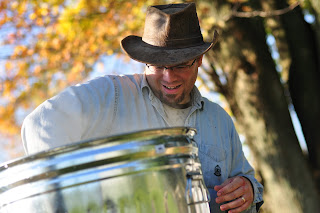
You need lots of room for the scald. I like my water at around 153 degrees. You may like it more or less. The choice is yours. The old timers say to put Dawn dish soap in your water. It cuts grease and therefore cuts the natural oils on the turkey feathers. I didn't do that and really didn't have any problems, but you may want to give it a try. Make sure you have enough room to swish the bird around. Here, you can see I used a 30 gallon galvanized garbage can. The burner is propane and from a turkey fryer (ironically enough). It was about 1/2 full when we used it. It worked great. For me, the stand was a little high and a step ladder would have worked well. I'm assuming, at this point, that you know about scalding. If not, you can google it or search YouTube and you'll find plenty of info. Scalding turkeys and chickens is about the same. The big differences is that the turkeys are MUCH heavier.


Plucking
You can pluck by hand. With the turkeys it's no problem. If you get that scald right, the feathers come out pretty easily. We used the Whizbang Chicken Plucker. You can learn more about it here. It can't handle a whole turkey being thrown in, but I put the turkey in and just rotated it myself. I'd estimate it took off at least 80% of the feathers. The rest of our "team" used pliers to finish off the plucking. That's very important. Make sure some patient people are there to help. Pull up a chair. Have a chat while you pluck. It's just like life should be...shared with others.


Evisceration (fancy word for gutting)
It's just like a chicken...only bigger. Check this video out for some detail.


Bagging
We have one person who is completely indispensable that does quality control after the evic..evis..the gutting. That person makes sure everything is out (if you know what I mean) and washes the bird down. Once that's done, you can either let them cool in water first, or bag them and then put them in water. It's your choice. We order or bags from Cornerstone Farm Ventures. Good products, good prices, and speedy delivery.


And there you have it.
So for you stat addicts, here's a wrap up:
And what a ride!
When we last left our little band of wild rebels, they were about 12 weeks old. I really had no idea how long to keep them. I had reports from different sources that you could keep them anywhere from 12 to 25 weeks depending on the size you wanted them. The "size" of a farm raised animal, however, can be very subjective. Size is based on a variety of factors: breed, feed, additives, pasture quality, conditions, weather, hatchery (or sire for non-poultry), stress, other livestock on the premises, etc. So you can see that to really plan your flock (as much as that is possible) requires a historical pattern that you can glean from. You have to know your feed, your pasture, your conditions, and the final outcomes of your livestock.
In this case, I had none of that.
As you may recall from a previous post, I fully expected to lose some or all of the turkey flock because of how I raised them. But God was merciful and we lost none of the 10 poults we purchased. So I let them grow. Around the 12 week mark, or so, I began to realize that they were putting on weight fast. And although we all like a big Thanksgiving Day turkey, there are limits. So we put a cap on the season at 18 weeks.
I am so glad we did that. We'll get to why I'm glad we did in a minute.
We ordered the Broad-breasted Bronze turkeys and, if you remember, I ordered a straight run. I found them to be a hardy breed that withstood a variety of less than perfect circumstances. They endured:
- Living with chicks
- Having their pen blow away
- Living for several days in a small chicken coop (while the pen was repaired)
- Wind gusts up to at least 30 miles an hour (see the point above about their pen)
- Heat well into the 90's (fairly high for Michigan)
- Unforgiving rain
- Nighttime cold into the mid 30's (fairly typical for Michigan in the fall)
- An insane farmer
- Lot's of insane farmer's kids
- Lot's of insane farmer's friends and family (read on...)
As they grow, you can start to tell which ones are Tom's and which are Jenny's. I think we ended up with 3 Tom's and 7 Jenny's. Now it's not an exact science, but the Tom's are usually pretty large. They all grew long fat waddles and a long beard (starts at the upper beak and grows long....kind of like ZZ Top). They also tend to fluff out their feathers and strut around the pen. This is because we ordered a straight run. You can certainly specify which gender you prefer.
The day finally arrived. We had decided to do the needful at age 18 weeks. Since I have a regular "town job", we always process on a Saturday. This was no exception. But the day was incredibly sunny, in the 70's (warm for us) and the sky was a beautiful blue. Yet another gift from God...
*WARNING* I am going to write in some detail about the processing event. I will not use excessive description as it is not necessary. However, there are pictures and as a fair warning, if you do not want to read about how the turkey's were dispatched, you may want to click over to another post.
Wrangling
Catching the birds was the most fun for the kids I think. Remember, they are more aggressive than chickens. The little Rough Riders tried a variety of methods including lassoing, trapping, and catching. The easiest way for us was to take a 5 gallon bucket with a hole at the end and slide it , top first, over the bird until it fits snugly inside. This quiets the bird and restrains its wings. See below for an explanation of the bucket.


Killing
Traditionally, the killing takes place in a killing cone. This is a bit of sheet metal folded into a cone. You can see it in the back of Sara Palin's


Scalding
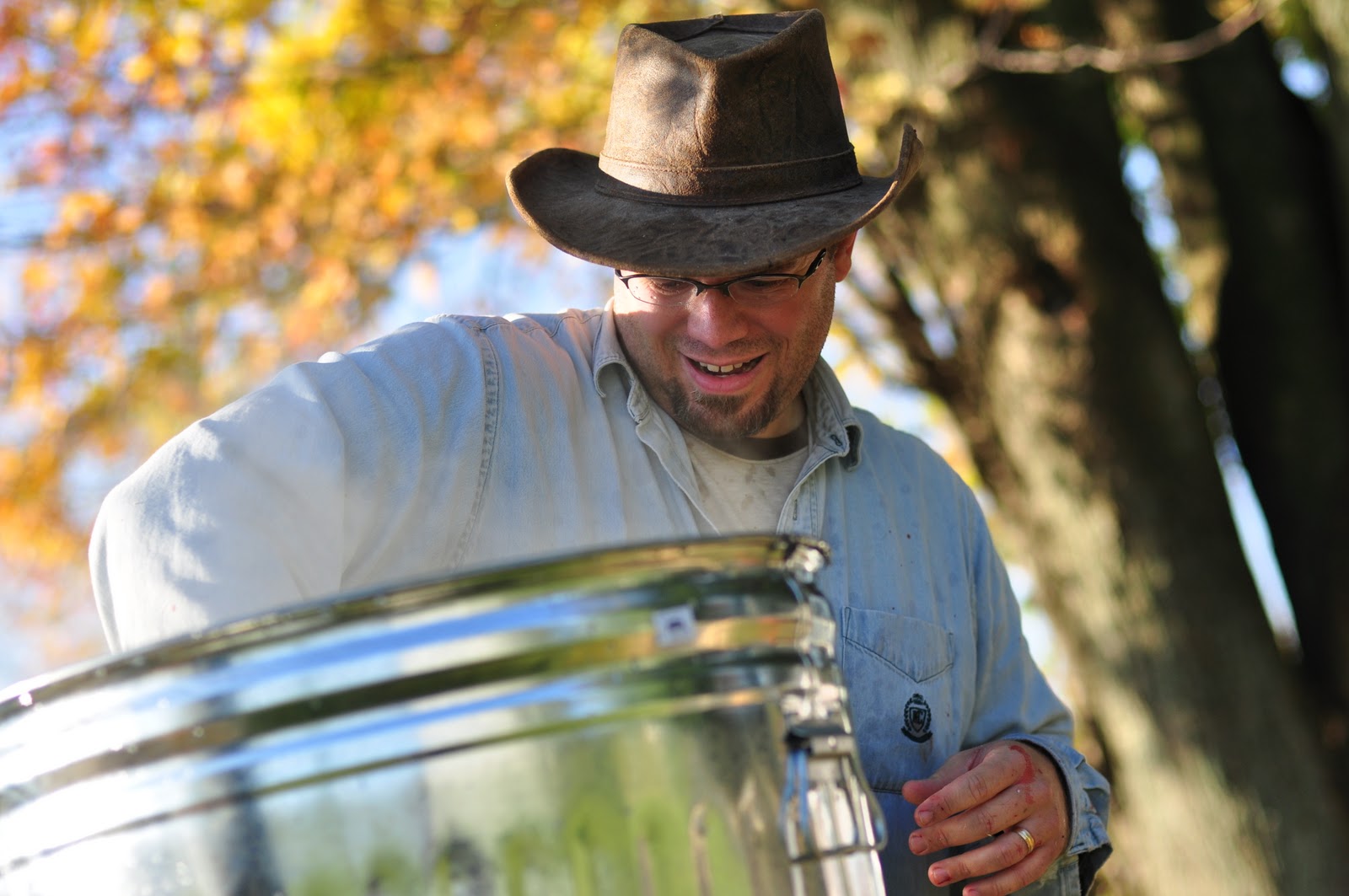
You need lots of room for the scald. I like my water at around 153 degrees. You may like it more or less. The choice is yours. The old timers say to put Dawn dish soap in your water. It cuts grease and therefore cuts the natural oils on the turkey feathers. I didn't do that and really didn't have any problems, but you may want to give it a try. Make sure you have enough room to swish the bird around. Here, you can see I used a 30 gallon galvanized garbage can. The burner is propane and from a turkey fryer (ironically enough). It was about 1/2 full when we used it. It worked great. For me, the stand was a little high and a step ladder would have worked well. I'm assuming, at this point, that you know about scalding. If not, you can google it or search YouTube and you'll find plenty of info. Scalding turkeys and chickens is about the same. The big differences is that the turkeys are MUCH heavier.


Plucking
You can pluck by hand. With the turkeys it's no problem. If you get that scald right, the feathers come out pretty easily. We used the Whizbang Chicken Plucker. You can learn more about it here. It can't handle a whole turkey being thrown in, but I put the turkey in and just rotated it myself. I'd estimate it took off at least 80% of the feathers. The rest of our "team" used pliers to finish off the plucking. That's very important. Make sure some patient people are there to help. Pull up a chair. Have a chat while you pluck. It's just like life should be...shared with others.


It's just like a chicken...only bigger. Check this video out for some detail.


Bagging
We have one person who is completely indispensable that does quality control after the evic..evis..the gutting. That person makes sure everything is out (if you know what I mean) and washes the bird down. Once that's done, you can either let them cool in water first, or bag them and then put them in water. It's your choice. We order or bags from Cornerstone Farm Ventures. Good products, good prices, and speedy delivery.


And there you have it.
So for you stat addicts, here's a wrap up:
- 9 friends to help (because they wanted to)
- 10 turkeys
- 7'x12' movable pen
- 18 weeks
- 200 gallons of water
- 950 pounds of feed
- Broad-breasted Bronze
- Smallest turkey - 15.5 pounds
- Largest turkey - 33.5 pounds
Subscribe to:
Posts (Atom)