In light of our last post, I've had several customers ask me where to get clean, fresh, local meat. The answer is always the same.
It ain't easy.
That said, I'd like to highlight a few small farms that are practicing various types of local farming. This is by no means an exhaustive list, so if you live in the southeastern part of Michigan, by all means chime in with some recommendations.
For lamb meat of any kind, there are two local favorites. First, there is the Chapman farm in the South Rockwood area. They've been in business for year. They've typically sold commercially but last year they told us they were trying to sell directly to the consumer (that's you!) They said then that if you just rolled on up to the house they'd sell you what they had. Call first though. I haven't spoken to them since last year.
There is also Hannewald. They frequent the Greenfield Village farmers market each fall. They are wonderfully nice people and their meat is terrific. I'm not sure what they have in terms of buying packages (shipping or pick up) but they are worth a call.
If it's beef you're after, some friends of ours bough from a ranch out west. I had some of the meat myself and it was very tasty. They do ship frozen meat and I think they are very reasonable with their shipping prices. The name is Scott River Ranch and you can check them out here.
There is a family that is doing all of the above as well as pork, milk, cheese, honey, eggs, and poultry. I highly recommend them for a one stop shop for all your needs. They are the Turtle Bee and Honey Tree farm. They don't ship. You have to pick up your products at the farm. They ask you to buy farm shares. You give them an agreed upon sum of money and then simply place your order. They keep record of what you put in and how much product you take. I think it's a great program that I may be able to emulate one day. Maybe...
When it comes to buying local fresh meat, eggs, and dairy I've got to say the pickin's are slim. I have some folks I get eggs from but they have small flocks. I encourage you to look around. I'm trying to talk a friend of mine into doing more farm to consumer transactions. I'm very encouraged in our conversations that we are of like mind. I'm hoping he'll be someone I can recommend in the future.
As for us, we're still looking for a farm in the area. Next year I hope to have chicken and turkey
for you. And who knows....maybe we'll get crazy and raise something
else. What about you? Do you have anyone to recommend? I'm sure we'd all love to hear about it. Not local? Who do you use in your area? What's your experience?
Showing posts with label turkeys. Show all posts
Showing posts with label turkeys. Show all posts
Saturday, April 21, 2012


Monday, March 26, 2012
Spring Newsletter 2012
I’d like to thank you for all your support and assistance in
last year’s business. We had several new
challenges last year including extreme heat.
Although we lost many birds to that heat, God blessed us and we still
managed to get the orders out. We also
had so many friends and customers come out to help us in various ways. I think that’s my favorite part. I love watching people come out, join
together, and accomplish something so ancient, so visceral, all the while
becoming a closer knit community. That’s
really what this is all about.
That said, we will not be fulfilling any orders this
year. I’m sorry to say that we are going
to need to take a year off. As many of
you know, my family is in the process of moving. We had anticipated being in a new house by
now, but God had different plans. As it
stands right now we have sold our house with an anticipated closing date of
early April. We are temporarily living
with my generous in-laws while we pack and look for another place. To compound the complexities our new son was
born on March 24th. Also, our good
friends, the Owen family, have been letting us use their farm. That family is very busy. The two youngest sons (who were vital in the
day to day operation) are both working full-time jobs and going to school. Keith, the patriarch of the farm, is also
very busy with work and ministry. So, as
I look across the landscape of the 2012 chicken season it appears to me that
God simply has a different plan for us.
While I am disappointed, I am glad to simply sit back and
watch. You may recognize that this is a
very poor business decision. However,
the main goal of Legacy Family Farm has never been “business”. The main goal is to leave a legacy of
Biblical community through agriculture.
We’ve been doing that. If the
Lord wills, we will do it again. When
that time comes, it is our sincere hope that you can be a part of it. Thanks for your support and your
understanding. We’d love to keep in
touch with you. I’ll continue posting on
our Facebook page from time to time. Let
us know about your experiences this year exploring other clean meat producing
farms, patronizing farmer’s markets, and entering into community with other
believers. We’d love to hear about it!
Feel free to contact us.
(734) 931-0890
legacyfamilyfarm@gmail.com
http://www.facebook.com/pages/Legacy-Family-Farm/201798028707
Wednesday, January 4, 2012
In Search of Land
The winter time is a great time of reflection. Once the poultry season begins in May, things get very busy. Only this year, it may be different. As I reflect on the coming year I'm at a loss for what may happen. It's gray and distant from this vantage point. I'm not scared though. I've been here before. Yet even though I may not be scared I must recognize that planning the rest of the year, at this point, is impossible.
As you know, I have a whole passel of kids. Right now we are a family of 7 wandering this wilderness together. Come March we're looking at a becoming a family of 8 and right now we live in a 1,000 square foot house in the suburbs.
Yes, I double checked those numbers and there are no typos.
We're living in our starter home. When we bought I didn't realize that we would be "starting" for the next 12 years. But never one to move too fast, I've steadily paid down our mortgage. My goal was to pay it down, collect some serious equity, and then put a big down payment on a bigger home. Then the market crashed. Like so many people I went under water for a while. Fortunately I was in a position to get my head above water quickly. That's primarily because I did have so much equity built up. I also failed to mention that I never intended to raise livestock. I always thought it would be very cool. My grandpa raised livestock and I loved helping him, but it always seemed like a pipe dream to me; something to long for and never achieve. That was my thinking until about 3 years ago. It was then that God began to show me a life where our family would raise livestock.
My friend, of course, let me use his land and we began raising poultry. It's been a great experience, but it's become very difficult to raise livestock at another farm. Logistically it's challenging. Each year I impose upon my friend and his family to help in the day to day care of the birds. They never complain, and I think to some degree they even like it, but it can be a burden to care for several hundred critters at the time.
And so I find myself searching for a house with a little bit of land in the country.
The vision I have is to set up a homestead with my family. I'd like to have a home a bit bigger than the one we have now and seated on some acreage. I'd like to grow a bigger garden than what we can today and plan to supply our table with as much of our homegrown fruits and vegetable as I can. I'd like to begin raising chickens, turkeys, rabbits, and sheep. Eventually I'd like to add cattle. I'd like to do all of this with the hope of giving to my children experience in hard work, sustainable living, and running a business. And then, I'd want to expand!
No, I'm talking about franchising or becoming a land baron. Rather I have a vision to work with other local people in the pursuit of creating an agrarian network. For instance, you might be shopping at your local farmers market. You see a booth where they are selling seeds they have harvested from heirloom vegetables, and you ask about chicken. The farmer let's you know that he can get chicken for you. The next week at the market you see him again and he indeed has fresh pastured chicken for you. What you don't know is that he doesn't raise chicken. He got it from me. But he's part of the "network". He's your reliable farmer. The people in the "network" trade and barter for fresh homemade/homegrown goods. In this way no one person has to bear the burden of having lots of land and working in every facet of the farm. Some may want to and I applaud them. Many of us cannot. But together we can create an agrarian community of producers and buyers alike, dedicated to preserving the past, feeding the present, and creating a sustainable future. In short, live a simple life.
As you know, I have a whole passel of kids. Right now we are a family of 7 wandering this wilderness together. Come March we're looking at a becoming a family of 8 and right now we live in a 1,000 square foot house in the suburbs.
Yes, I double checked those numbers and there are no typos.
We're living in our starter home. When we bought I didn't realize that we would be "starting" for the next 12 years. But never one to move too fast, I've steadily paid down our mortgage. My goal was to pay it down, collect some serious equity, and then put a big down payment on a bigger home. Then the market crashed. Like so many people I went under water for a while. Fortunately I was in a position to get my head above water quickly. That's primarily because I did have so much equity built up. I also failed to mention that I never intended to raise livestock. I always thought it would be very cool. My grandpa raised livestock and I loved helping him, but it always seemed like a pipe dream to me; something to long for and never achieve. That was my thinking until about 3 years ago. It was then that God began to show me a life where our family would raise livestock.
My friend, of course, let me use his land and we began raising poultry. It's been a great experience, but it's become very difficult to raise livestock at another farm. Logistically it's challenging. Each year I impose upon my friend and his family to help in the day to day care of the birds. They never complain, and I think to some degree they even like it, but it can be a burden to care for several hundred critters at the time.
And so I find myself searching for a house with a little bit of land in the country.
The vision I have is to set up a homestead with my family. I'd like to have a home a bit bigger than the one we have now and seated on some acreage. I'd like to grow a bigger garden than what we can today and plan to supply our table with as much of our homegrown fruits and vegetable as I can. I'd like to begin raising chickens, turkeys, rabbits, and sheep. Eventually I'd like to add cattle. I'd like to do all of this with the hope of giving to my children experience in hard work, sustainable living, and running a business. And then, I'd want to expand!
No, I'm talking about franchising or becoming a land baron. Rather I have a vision to work with other local people in the pursuit of creating an agrarian network. For instance, you might be shopping at your local farmers market. You see a booth where they are selling seeds they have harvested from heirloom vegetables, and you ask about chicken. The farmer let's you know that he can get chicken for you. The next week at the market you see him again and he indeed has fresh pastured chicken for you. What you don't know is that he doesn't raise chicken. He got it from me. But he's part of the "network". He's your reliable farmer. The people in the "network" trade and barter for fresh homemade/homegrown goods. In this way no one person has to bear the burden of having lots of land and working in every facet of the farm. Some may want to and I applaud them. Many of us cannot. But together we can create an agrarian community of producers and buyers alike, dedicated to preserving the past, feeding the present, and creating a sustainable future. In short, live a simple life.
Thursday, October 14, 2010
Talking Turkey - Part 2
In a part 1 of Talking Turkey, I promised I'd document the rest of the season so you could get an idea of what it takes to raise turkeys. So here I am.
And what a ride!
When we last left our little band of wild rebels, they were about 12 weeks old. I really had no idea how long to keep them. I had reports from different sources that you could keep them anywhere from 12 to 25 weeks depending on the size you wanted them. The "size" of a farm raised animal, however, can be very subjective. Size is based on a variety of factors: breed, feed, additives, pasture quality, conditions, weather, hatchery (or sire for non-poultry), stress, other livestock on the premises, etc. So you can see that to really plan your flock (as much as that is possible) requires a historical pattern that you can glean from. You have to know your feed, your pasture, your conditions, and the final outcomes of your livestock.
In this case, I had none of that.
As you may recall from a previous post, I fully expected to lose some or all of the turkey flock because of how I raised them. But God was merciful and we lost none of the 10 poults we purchased. So I let them grow. Around the 12 week mark, or so, I began to realize that they were putting on weight fast. And although we all like a big Thanksgiving Day turkey, there are limits. So we put a cap on the season at 18 weeks.
I am so glad we did that. We'll get to why I'm glad we did in a minute.
We ordered the Broad-breasted Bronze turkeys and, if you remember, I ordered a straight run. I found them to be a hardy breed that withstood a variety of less than perfect circumstances. They endured:
As they grow, you can start to tell which ones are Tom's and which are Jenny's. I think we ended up with 3 Tom's and 7 Jenny's. Now it's not an exact science, but the Tom's are usually pretty large. They all grew long fat waddles and a long beard (starts at the upper beak and grows long....kind of like ZZ Top). They also tend to fluff out their feathers and strut around the pen. This is because we ordered a straight run. You can certainly specify which gender you prefer.
The day finally arrived. We had decided to do the needful at age 18 weeks. Since I have a regular "town job", we always process on a Saturday. This was no exception. But the day was incredibly sunny, in the 70's (warm for us) and the sky was a beautiful blue. Yet another gift from God...
*WARNING* I am going to write in some detail about the processing event. I will not use excessive description as it is not necessary. However, there are pictures and as a fair warning, if you do not want to read about how the turkey's were dispatched, you may want to click over to another post.
Wrangling
Catching the birds was the most fun for the kids I think. Remember, they are more aggressive than chickens. The little Rough Riders tried a variety of methods including lassoing, trapping, and catching. The easiest way for us was to take a 5 gallon bucket with a hole at the end and slide it , top first, over the bird until it fits snugly inside. This quiets the bird and restrains its wings. See below for an explanation of the bucket.


Killing
Traditionally, the killing takes place in a killing cone. This is a bit of sheet metal folded into a cone. You can see it in the back of Sara Palin's


Scalding
You need lots of room for the scald. I like my water at around 153 degrees. You may like it more or less. The choice is yours. The old timers say to put Dawn dish soap in your water. It cuts grease and therefore cuts the natural oils on the turkey feathers. I didn't do that and really didn't have any problems, but you may want to give it a try. Make sure you have enough room to swish the bird around. Here, you can see I used a 30 gallon galvanized garbage can. The burner is propane and from a turkey fryer (ironically enough). It was about 1/2 full when we used it. It worked great. For me, the stand was a little high and a step ladder would have worked well. I'm assuming, at this point, that you know about scalding. If not, you can google it or search YouTube and you'll find plenty of info. Scalding turkeys and chickens is about the same. The big differences is that the turkeys are MUCH heavier.


Plucking
You can pluck by hand. With the turkeys it's no problem. If you get that scald right, the feathers come out pretty easily. We used the Whizbang Chicken Plucker. You can learn more about it here. It can't handle a whole turkey being thrown in, but I put the turkey in and just rotated it myself. I'd estimate it took off at least 80% of the feathers. The rest of our "team" used pliers to finish off the plucking. That's very important. Make sure some patient people are there to help. Pull up a chair. Have a chat while you pluck. It's just like life should be...shared with others.


Evisceration (fancy word for gutting)
It's just like a chicken...only bigger. Check this video out for some detail.


Bagging
We have one person who is completely indispensable that does quality control after the evic..evis..the gutting. That person makes sure everything is out (if you know what I mean) and washes the bird down. Once that's done, you can either let them cool in water first, or bag them and then put them in water. It's your choice. We order or bags from Cornerstone Farm Ventures. Good products, good prices, and speedy delivery.


And there you have it.
So for you stat addicts, here's a wrap up:
And what a ride!
When we last left our little band of wild rebels, they were about 12 weeks old. I really had no idea how long to keep them. I had reports from different sources that you could keep them anywhere from 12 to 25 weeks depending on the size you wanted them. The "size" of a farm raised animal, however, can be very subjective. Size is based on a variety of factors: breed, feed, additives, pasture quality, conditions, weather, hatchery (or sire for non-poultry), stress, other livestock on the premises, etc. So you can see that to really plan your flock (as much as that is possible) requires a historical pattern that you can glean from. You have to know your feed, your pasture, your conditions, and the final outcomes of your livestock.
In this case, I had none of that.
As you may recall from a previous post, I fully expected to lose some or all of the turkey flock because of how I raised them. But God was merciful and we lost none of the 10 poults we purchased. So I let them grow. Around the 12 week mark, or so, I began to realize that they were putting on weight fast. And although we all like a big Thanksgiving Day turkey, there are limits. So we put a cap on the season at 18 weeks.
I am so glad we did that. We'll get to why I'm glad we did in a minute.
We ordered the Broad-breasted Bronze turkeys and, if you remember, I ordered a straight run. I found them to be a hardy breed that withstood a variety of less than perfect circumstances. They endured:
- Living with chicks
- Having their pen blow away
- Living for several days in a small chicken coop (while the pen was repaired)
- Wind gusts up to at least 30 miles an hour (see the point above about their pen)
- Heat well into the 90's (fairly high for Michigan)
- Unforgiving rain
- Nighttime cold into the mid 30's (fairly typical for Michigan in the fall)
- An insane farmer
- Lot's of insane farmer's kids
- Lot's of insane farmer's friends and family (read on...)
As they grow, you can start to tell which ones are Tom's and which are Jenny's. I think we ended up with 3 Tom's and 7 Jenny's. Now it's not an exact science, but the Tom's are usually pretty large. They all grew long fat waddles and a long beard (starts at the upper beak and grows long....kind of like ZZ Top). They also tend to fluff out their feathers and strut around the pen. This is because we ordered a straight run. You can certainly specify which gender you prefer.
The day finally arrived. We had decided to do the needful at age 18 weeks. Since I have a regular "town job", we always process on a Saturday. This was no exception. But the day was incredibly sunny, in the 70's (warm for us) and the sky was a beautiful blue. Yet another gift from God...
*WARNING* I am going to write in some detail about the processing event. I will not use excessive description as it is not necessary. However, there are pictures and as a fair warning, if you do not want to read about how the turkey's were dispatched, you may want to click over to another post.
Wrangling
Catching the birds was the most fun for the kids I think. Remember, they are more aggressive than chickens. The little Rough Riders tried a variety of methods including lassoing, trapping, and catching. The easiest way for us was to take a 5 gallon bucket with a hole at the end and slide it , top first, over the bird until it fits snugly inside. This quiets the bird and restrains its wings. See below for an explanation of the bucket.


Killing
Traditionally, the killing takes place in a killing cone. This is a bit of sheet metal folded into a cone. You can see it in the back of Sara Palin's


Scalding
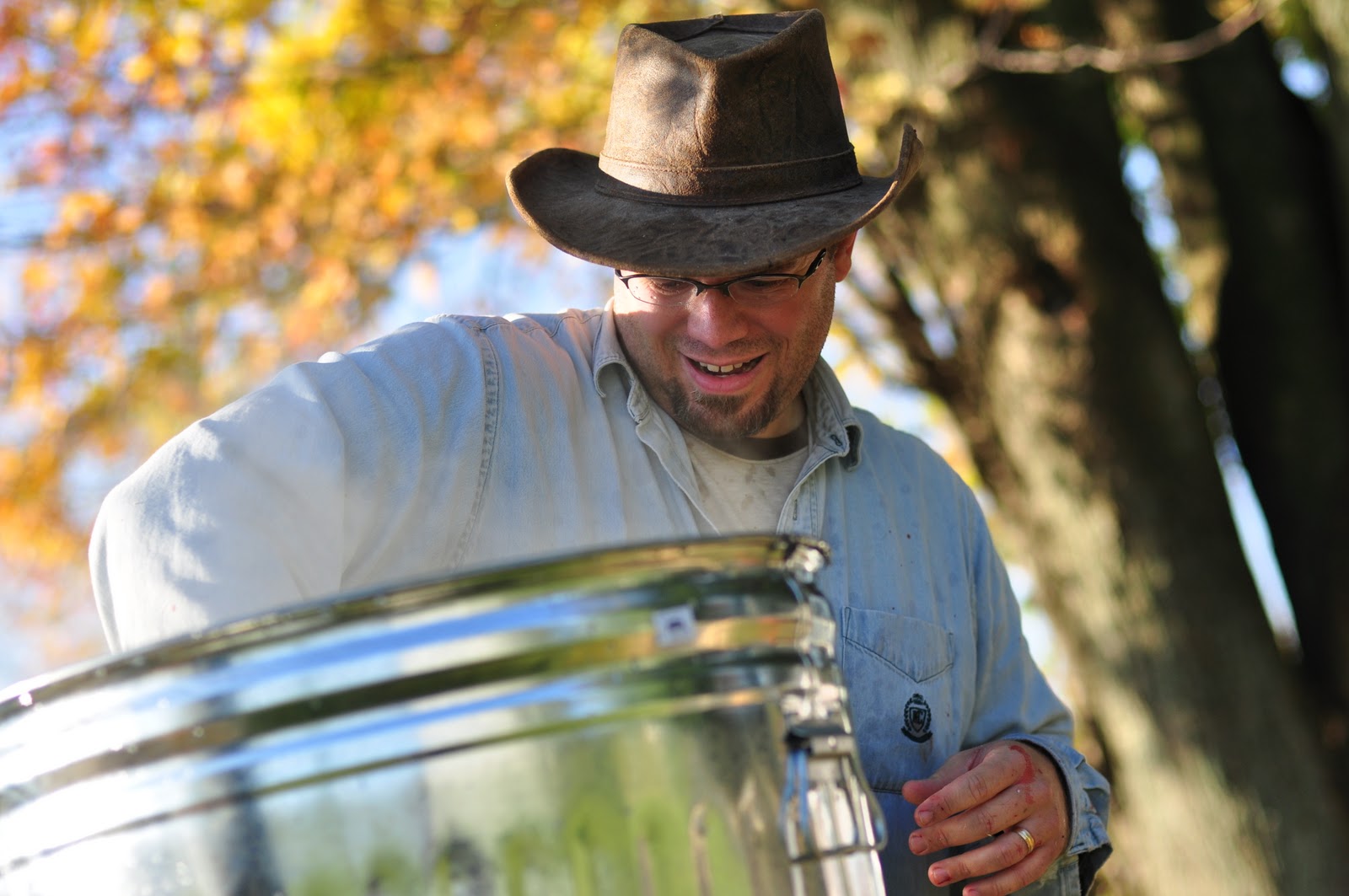
You need lots of room for the scald. I like my water at around 153 degrees. You may like it more or less. The choice is yours. The old timers say to put Dawn dish soap in your water. It cuts grease and therefore cuts the natural oils on the turkey feathers. I didn't do that and really didn't have any problems, but you may want to give it a try. Make sure you have enough room to swish the bird around. Here, you can see I used a 30 gallon galvanized garbage can. The burner is propane and from a turkey fryer (ironically enough). It was about 1/2 full when we used it. It worked great. For me, the stand was a little high and a step ladder would have worked well. I'm assuming, at this point, that you know about scalding. If not, you can google it or search YouTube and you'll find plenty of info. Scalding turkeys and chickens is about the same. The big differences is that the turkeys are MUCH heavier.


Plucking
You can pluck by hand. With the turkeys it's no problem. If you get that scald right, the feathers come out pretty easily. We used the Whizbang Chicken Plucker. You can learn more about it here. It can't handle a whole turkey being thrown in, but I put the turkey in and just rotated it myself. I'd estimate it took off at least 80% of the feathers. The rest of our "team" used pliers to finish off the plucking. That's very important. Make sure some patient people are there to help. Pull up a chair. Have a chat while you pluck. It's just like life should be...shared with others.


It's just like a chicken...only bigger. Check this video out for some detail.


Bagging
We have one person who is completely indispensable that does quality control after the evic..evis..the gutting. That person makes sure everything is out (if you know what I mean) and washes the bird down. Once that's done, you can either let them cool in water first, or bag them and then put them in water. It's your choice. We order or bags from Cornerstone Farm Ventures. Good products, good prices, and speedy delivery.


And there you have it.
So for you stat addicts, here's a wrap up:
- 9 friends to help (because they wanted to)
- 10 turkeys
- 7'x12' movable pen
- 18 weeks
- 200 gallons of water
- 950 pounds of feed
- Broad-breasted Bronze
- Smallest turkey - 15.5 pounds
- Largest turkey - 33.5 pounds
Tuesday, September 28, 2010
That's a Wrap
Whew!
We finally finished raising and processing all 213 chickens. What a summer!
 I was standing in the field last Saturday in the early morning hours. My sons and I were preparing for the day. The sun was just coming up and the chill of the night was still in the air. I thought about the people who were coming out to help.
I thought about how they always come out to help.
I was tired and ready to be done with chicken processing days. They are long, messy, and tiring. I thought about the helpers. How tired of chicken processing days must they be? They show up on the days they are able. They work hard and without complaint. When they are finished they are rewarded with little to nothing.

And still they come. Why?
They come because of the love they have in their hearts. For me and my family, yes, but more importantly because they love God and His people. That's what Biblical community is all about. It's about sacrificing your time and resource for your brother or sister...even if they are crazy enough to process chickens.
At that moment, I was overwhelmed with gratitude. Maybe overwhelmed is not the right word. Maybe humbled is better. Yes, I think that says it better. Humbled because I realized anew that I didn't deserve friends like these. I didn't deserve the blessing of living in the family of God. Yet I was blessed. I am blessed. How could life get any better?


Thank you to all who are supporting this little enterprise. I appreciate the encouragement and enthusiasm you give toward the service we are providing. It's been exciting watching as people's faces light up when they realize what we're doing. Whether you are supporting clean and healthy meat, a local business, a strange new business venture, or all of the above, we thank you. I'll still be posting updates on our Turkey experiment so stay tuned. I have a feeling that Turkey processing day will be an adventure!
We finally finished raising and processing all 213 chickens. What a summer!

I thought about how they always come out to help.
I was tired and ready to be done with chicken processing days. They are long, messy, and tiring. I thought about the helpers. How tired of chicken processing days must they be? They show up on the days they are able. They work hard and without complaint. When they are finished they are rewarded with little to nothing.

And still they come. Why?
They come because of the love they have in their hearts. For me and my family, yes, but more importantly because they love God and His people. That's what Biblical community is all about. It's about sacrificing your time and resource for your brother or sister...even if they are crazy enough to process chickens.
At that moment, I was overwhelmed with gratitude. Maybe overwhelmed is not the right word. Maybe humbled is better. Yes, I think that says it better. Humbled because I realized anew that I didn't deserve friends like these. I didn't deserve the blessing of living in the family of God. Yet I was blessed. I am blessed. How could life get any better?


Thank you to all who are supporting this little enterprise. I appreciate the encouragement and enthusiasm you give toward the service we are providing. It's been exciting watching as people's faces light up when they realize what we're doing. Whether you are supporting clean and healthy meat, a local business, a strange new business venture, or all of the above, we thank you. I'll still be posting updates on our Turkey experiment so stay tuned. I have a feeling that Turkey processing day will be an adventure!
Tuesday, August 31, 2010
Talking Turkey - Part 1

I posted once before that there is not nearly as much on line about raising turkeys as there is about raising chickens. So, as best i can I'm going to chronicle what we've done so far.
Now, remember, this is my first shot at Turkey's so all I have to go on is what I've done this year. You'll have to take it for what it's worth.
I ordered the poults (baby turkeys) in April. I ordered them to arrive the week before the Memorial Day weekend, but that didn't happen. They arrived the first week in June. I ordered a straight run, that is, males and females. Normally, when I order the chickens, I order only cockerels (males). I have to admit that the one thing that bothers me about raising poultry is that everyone orders cockerels for meat birds. They have a better chance of growing large quickly. But what do they do with the females that are born? Well, if no one wants them for layers, they are destroyed. It just seems like a colossal waste. So, I ordered a straight run for the poults.
I raise chickens for meat, too, so it made sense to order them together. I ordered 70 chickens and 10 turkeys. So, again, logistically it didn't make sense to build a second brooder and double the effort of feeding, watering, and heating. Here's where the debate comes in.
Traditional farmers say that you cannot, under any circumstance, combine chickens and turkeys'. There is a disease, the Blackhead, that chickens carry but are immune to. For turkey's, however, it's most often fatal. so the solution is to separate them at all cost. Farmers that tend toward the organic methods say it's okay to leave them together, at least when they are small. Then comes the debate on how long to leave them together. And on the debates go. I had a chance to participate in Joel Salatin's Farm Days a couple years back. They keep chicks and poults together and the mortality rate was surprisingly low. So my logic goes something like this. Joel Salatin does it...good enough for me.

And so they lived communally for about two weeks. I was surprised to see that at the end of two weeks, the poults were able to easily fly out of my 2 foot high brooder. If you're going to brood them that long or longer, I would suggest either a 3 foot high brooder, or the use of a lid. I will add that 2 feet in no way cramped them. There was still plenty of height. The addition of a lid is only required to keep them from flying out. During this time, I also fed the chicks and poults the same ration. Of course turkey's require a ration higher in protein (28% to start with), but again, it would be an addition to the process to feed them separate feed from separate feeders, and so on. I opted to feed them the same ration. It didn't seem to impede them at all.

After the two weeks, we brought them out to pasture. I separated the chickens from the turkeys Now the ten poults had their own place. I also switched them to the Turkey Starter ration. I placed the pens close to one another. I have been warned that they need to be kept far from one another, but again, the process dictated that they can't be too far apart. If they are, I lose valuable time in moving from one place to another. So they are about seven feet from one another.
They are twelve weeks old as I write this post. They must be about 10-12 pounds apiece. We had a major wind storm that you can read about here, but we didn't lose any of them. Thus far, disease has been non-existent. Predators have not posed a problem. They are growing really very well. I've switched to a grower ration with a 25% protein ration. It's pelleted, cheaper, and more efficient for them at this time. I still mix in the Fertrell Nutri-Balance which you can read about here.
Now, fair warning. They are aggressive. I try to incorporate my children into all the things I do with the poultry. In this case, they are not allowed to go in the Turkey pen unless an adult knows about it. The children are all 10 and under so it's very possible a turkey could fly up and spur them in the face. That said, we've had no injury thus far to either friend or fowl. We take it seriously. We have fun (for sure) but we know that the birds are living and must be treated with respect.
So that's what I have for now. I'll keep you posted on how the rest of this little experiment goes. Lord willing, we'll have Turkey from our own pasture to be thankful for this November.
Mmmmm....I can smell it now.....
Subscribe to:
Posts (Atom)