Showing posts with label process. Show all posts

Monday, August 16, 2010

Cloning Beef

Laudanum, Morphine, Cocaine, Saccharine, Tobacco, Lead, Mercury....

What do all of these have in common?  At one time in history they all had valid uses, some medicinal, and some practical.  During their heyday they were applauded by the leading citizens of society as necessary for a modern, civilized life.  Best of all, they were completely safe.

Nothing to worry about.

Yet as our science progressed, we determined that each one had some very negative properties.  So we made changes.

We found less addictive means of pain control.

We put warning labels on harmful substances.

We removed what we could from common household items.

In most cases we have shunned these evils of mankind.

And yet....

I recently read of story from the Telegraph, a publication from the UK.  You may have heard of the uproar in the UK and Europe regarding the beef they are buying off the shelves.  It's from cloned animals.  And it's not labeled.


In other countries, it is illegal to sell cloned meat without the proper labeling.  In addition, the correct paperwork has to be filed indicating that cloned beef has been brought into the county.  Apparently this didn't happen the way it's supposed to.  Yet in America, we have no labels on our beef.  Conventionally grown hamburger can, and is, mixed in with hamburger from the offspring of cloned beef.  It seems that the American public at large is basically unaware that this happens.  Many who are aware have no problem with consuming the offspring of cloned beef.  So what's the big deal overseas?

Joanna Blythman reports, "Cloning can sound like a neat, useful science. What farmer wouldn't want to make Identikit copies of his best milker or his leanest, fastest-growing pig?  In reality, this technology is hopelessly hit-and-miss, generating a steady roll-call of deaths and defects.  First, the embryo has to be implanted into a surrogate mother using a potentially painful surgical procedure. If they do not miscarry, these mothers often don't give birth naturally and must instead undergo a caesarean."

The “big deal” in Europe is that the people recognize that there is not enough empirical data, hard evidence, that the cloned meat is exactly like it's natural counterpart.  While I appreciate science and the many benefits it has brought to the masses, I do not think it wise to accept the verdict that cloned beef is in every way exactly like it’s natural counterpart.  Like the list that started this post, could cloned beef go the way of the many things once deemed safe, but then condemned?

And one last thought.  Why is it that we try to improve on what God has already ordained only to find that His way was best after all?

Tuesday, July 20, 2010

One Batch Down

We finished processing the first batch of chickens this past Saturday.  And what a day it was!  We arrived at the farm (my friends homestead) at 6:30 a.m. to set up.  From there it was a whirlwind of a day.  65 chickens were plucked, processed, and bagged.  I'd go into more detail....well, maybe not.

Several friends showed up to help and all were veteran chicken processors from last year.  What a wonderful thing it is to have strong relationships.  Only one person was specifically asked to come and help, yet several showed up, some unexpectedly, simply to show their support and love.  That's what we hope our little farming venture does; we hope it leaves a legacy of Biblical community through agriculture.


There were some who managed to escape the camera, but they were a very real part of the experience.  And I promise that after 12 hours it was not all smiles.  I thank you all for your help.

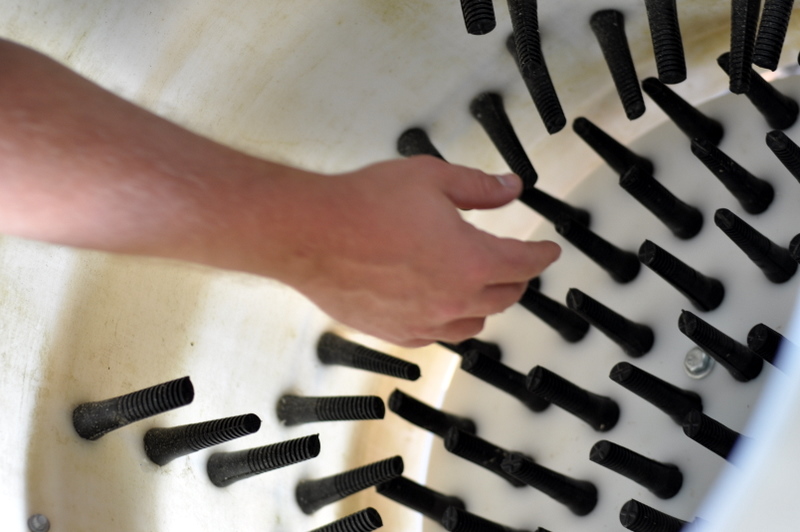
This year, we used something new.  It's a chicken plucker fabricated by a good friend.  The design came from a man named Herrick Kimble.  You can read more about him here.  The parts came from all over.  Some new and some not so new.  It worked pretty good, but needs a couple of tweaks before our next processing day.  It plucked them clean...which is more than I can say for the few I hand plucked!


The biggest question I get asked is "What will they look like when I come to pick them up?"  For our area, that's a valid question.  This is so new to most of us.  When you come to pick them up you'll find that they have no head or feet.  They will be plucked clean. All of the insides are taken out.  Then we bag 'em and tag 'em.  In the end they get weighed so you know what you'll pay.  It's that simple.

Here is a picture of a bagged chicken.  This one's been frozen, but it gives you an idea of what it looks like.

We don't quarter them or de-bone them...that would take a lot of time.  For a good tutorial on quartering chickens, look to your favorite chef.  Most of them have a section in their cookbooks on how to butcher a chicken.  I think it's a lost art.

So many people came out.  Some were customers and some just came to check out the action.  All of them left as customers.  It was exciting to watch it all happen.  Thanks to those who bought and those who helped.  We couldn't have done it without you!

Monday, December 14, 2009

Big Business

I've had opportunity at times in my life to study big corporations....mostly because I worked at them.  Taking it all in stride, I have found it much easier to work with smaller companies.  One family owned company I worked for a number of years ago now goes down in my history as the best place I've worked.  As I look at some of my other faves I see a line of similarity: the location or department I was in worked like a small business within a big business.

Now, to be fair, I want to own my own business so that colors my thoughts.  But recently it dawned on me why the functions in a big corporation (and I've worked for several) always seems disjointed.  It occurred to me that they are trying to function in a way that is unnatural.  Here's what I mean....

In every corporate environment everywhere (I think that's a politically correct thing to say) whether it's a church (that's probably not a politically correct thing to say), a fortune 500 company, or the little mom and pop shop down the street, the people working there know who can get the job done.  If you need this document typed out in a hurry, you talk to Jimmy.  If you need a good deal on supplies, you talk to Sue.  If you want this project on time, you give it to Ralph.  Whatever "it" is, you know who's gonna get it done.  The reality is that for things to get done in any size company, you have to deal with it relationally. 

Most big corporations, including mega churches and the like, adopt a process model that allows them to produce their widgets in the most efficient and concise manner.  I've been involved in and used those processes for many years now.  Looking at it objectively, it's obvious to me that these processes, developed by the intelligentsia of the age, are as solid as they can be.  Yet they all over look one thing; reality.  They expect humans to follow through with them.  That's really the laughable part of it all.  From what I've seen (and there may be exceptions) the process that has been adopted holds true...for a while.  But eventually, it's all gonna hit the fan and the person who has the most pressure on them will resort to that animal instinct that God placed within them to seek out another person.  They will seek out that person that will get it done, the person they feel the most safe with.  In the end, the process fails us because we need to deal with pressure and problems relationally to feel that we've actually accomplished something.

In an environment where that is not factored in, the process seems ludicrous.  The team tends to rebel against the process because "it doesn't work." Those people who were over burdened before the process came in become even more overburdened because they are expected to follow, loosely, the process for appearance sake while still accomplishing the work in the same old way.  Thus, the whole things seems, somehow, unnatural.

I have not seen an environment where this was not so in one degree or other.  However, some companies do better when they know that the human factor will kick in and they allow some leeway in the process that allows people to do what they do naturally....handle things relationally within the framework of a process.

And still I contend that work is most often done well in the case of a small, privately owned company.  They tend to live off the relationships they've built.  Take care of the people and they take care of you.  It's no panacea I know, but somehow it does seem more natural, doesn't it?

I'll have more to say about working in big corporations in the future.  For now, it is enough to know that no matter where you are and what job you do, relationships are vital.  Remember that and you will build a team around you that will get the job done.  Count on it.